

| Attribute | Value |
|---|---|
| Product Category: | |
| Manufacturer: | TE Connectivity |
| Manufacturer Part Number: | TE Connectivity 2221860-5 |
| Gender: | Crimp Snap |
| Housing Material: | Thermoplastic |
| Mount Type: | Panel |
| Termination Method: | Crimp |
| Pitch: | .09 in, 2.29 mm |
| Shell Size: | 5 |
| Contact Size: | 22 |
| Shell Plating: | Zinc |
| Insert Material: | Thermoplastic |
| Contact Amperage: | 5 A |
| Number of Positions: | 78 |
| Housing Color: | Black |
| GPL: | 243 |
| Shield Material: | Steel |
| Shell Material: | Carbon Steel |
| Operating Temperature Range: | -55 - 125 °C, -67 - 257 °F |
| Circuit Application: | Signal |
| Shielded: | No |
| Sealable: | Yes |
| GPL Description: | Aerospace Defense & Marine |
| Connector and Contact Terminate To: | Wire & Cable |
| Product Code: | X536 |
| Connector System: | Cable-to-Cable |
| Connector Product Type: | Connector |
| ECCN: | EAR99 |
| Mating Connector Lock: | Without |
| Retainer Clip Material: | Stainless Steel |
| Grommets: | With |
| Grounding Indents: | Without |
| Shell Type: | Metal |
| Insert Flammability Standard: | V-0 |
| Part Aliases: | 2221860-5 |
| SKU: | AMP2221860-5 |
2221860-5
Specifications
Detailed Description
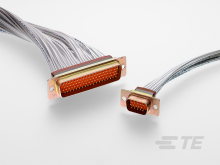
Introducing the AMPLIMITE IP67 Crimp Snap Connector, a rugged and reliable solution for your connectivity needs. Featuring a 78-position, 22-size configuration, this connector is perfect for signal applications in demanding environments. With a panel mount design and thermoplastic housing, it ensures secure and durable performance. Operating within a wide temperature range of -55 to 125°C, it's suitable for aerospace, defense, and marine applications. This connector is wave solder capable, making it easy to integrate into your assembly process. Its black housing, zinc shell plating, and steel shield construction offer both durability and versatility. With sealable properties and V-0 insert flammability standard compliance, it guarantees safe and efficient operation. Whether in cable-to-cable setups or wire and cable terminations, this connector is the perfect choice for your connectivity requirements.
For Use With
| Product | Part # | Description | Stock |
|---|---|---|---|
 | TE Connectivity 205089-1 |  |
Availability
In Stock:
Call
Stock Location:
In Stock
Factory Stock:
Call for Stock
Factory Lead:
Call
Unit Of Measure:
Each
Minimum/Multiple:
1/1
Invalid quantity value

Documents & Media
Environmental & Export Classifications
| Attribute | Value |
|---|---|
| RoHS Compliant: | Unkown |